Discover why heavy-duty T3 inverter compressor technology is essential for surviving 45°C to 53°C+ extreme heat in Sindh, Punjab, and Karachi. Compare cooling deratings, voltage stability, and Gold Fin corrosion resistance.
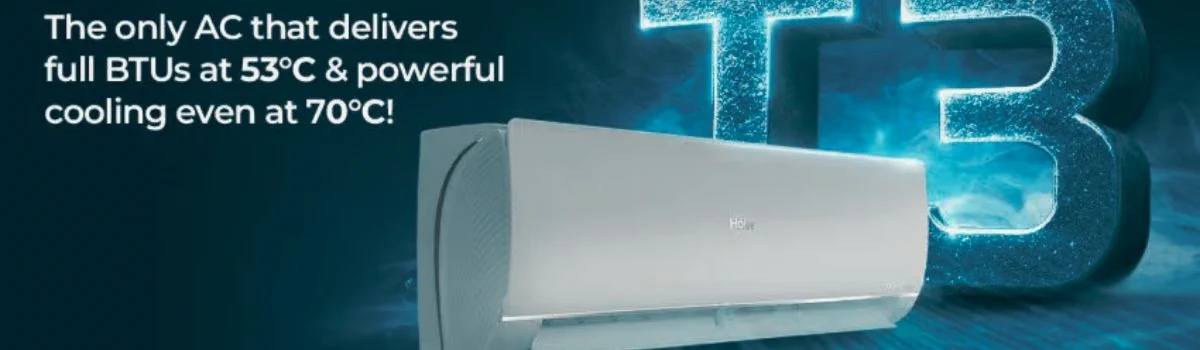
Every summer between May and August, thousands of homeowners, commercial offices, and retail showrooms across Karachi, Sukkur, Multan, Faisalabad, and Lahore experience the exact same frustrating failure: during the sweltering afternoon peak—precisely when cooling is desperately needed—their air conditioners begin blowing lukewarm air or shut down entirely.
The culprit is rarely a lack of refrigerant gas or an electrical fault. Instead, the unit is equipped with a standard T1 climate compressor designed for mild European or temperate East Asian climates, which cannot withstand Pakistan’s punishing summer ambient heat and intense rooftop solar radiation.
Understanding the engineering differences between T1 (Moderate Climate) and heavy-duty T3 (Tropical Climate) inverter air conditioners—alongside advanced technologies like liquid PCB cooling and hyper-wide voltage stabilization—is the key to uninterrupted cooling comfort throughout the harshest Pakistani summers.
The Thermodynamic Challenge: Why Standard T1 Compressors Fail Above 43°C
Air conditioners do not generate "coldness"; they extract thermal energy from indoor air and reject it outdoors through the condenser coil.
Under international ISO 5151 air conditioning testing standards, air conditioning systems are classified into distinct climate zones based on ambient operating envelopes:
1. T1 Climate Class (Moderate / Temperate)
- Standard Testing Rating: Rated cooling capacity is measured at 35°C outdoor ambient and 27°C indoor dry bulb.
- Maximum Thermal Limit: Designed to operate up to an absolute outdoor limit of 43°C.
- The Breakdown Mechanism: Once outdoor ambient air exceeds 42°C, the temperature differential between the hot outdoor air and the refrigerant condensing coil narrows drastically. Condensing head pressure of R410A or R32 refrigerant skyrockets past critical safety thresholds (>4.2 MPa / 600 PSI).
- Thermal Overload Tripping: To prevent the motor windings from melting, the internal Overload Protector (OLP) trips power to the compressor. The indoor fan keeps blowing ambient room air, leaving occupants in stifling heat until the outdoor unit cools down hours later.
- Capacity Derating: Even before tripping, a standard 1.5 Ton (18,000 BTU) T1 unit loses 30% to 40% of its cooling capacity at 45°C, functioning like a weak 0.9 Ton unit.
2. T3 Climate Class (Tropical / Desert Extreme)
- Standard Testing Rating: Rated capacity is tested and guaranteed at 46°C outdoor ambient.
- Extreme Heat Tolerance: Engineered specifically for Middle Eastern and South Asian desert climates, authentic T3 units maintain continuous refrigeration cycles at ambient temperatures from 46°C to 53°C, with flagship models sustaining active cooling even when rooftop ambient heat reaches an astonishing 68°C to 70°C.
- Sustained 100% BTU Delivery: Heavy-displacement T3 compressors deliver full rated British Thermal Units (18,000 BTU/h for a 1.5 Ton unit) at 53°C ambient heat without thermal derating or overload tripping.
ISO 5151 Climate Classification Matrix
Engineering Breakthroughs Inside Modern T3 Inverter ACs
Industry leaders such as Haier and Gree have engineered proprietary technologies to overcome the unique environmental hurdles of Pakistan:
1. Twin-Rotary DC Inverter Compressors
Rather than relying on a single off-center piston, T3 inverters feature dual balanced compression chambers operating 180 degrees out of phase. This cancels internal mechanical vibrations, reduces friction, and allows the compressor to spin at high frequencies (up to 120 Hz) without overheating.
2. Active Liquid-Refrigerant PCB Cooling Loop
In traditional split ACs, the sensitive inverter PCB motherboard housed in the outdoor unit is cooled solely by ambient outdoor air. When rooftop ambient air hits 50°C, the outdoor PCB heats up to over 85°C, triggering electronic error codes (such as E6 or F1) and shutting down the system.
Flagship T3 inverters incorporate a specialized copper micro-channel cooling plate underneath the high-power IGBT inverter chips. Sub-cooled liquid refrigerant circulates directly through the heat sink, maintaining PCB temperatures below 60°C even in 68°C rooftop ambient heat.
3. Electronic Expansion Valves (EEV)
While budget air conditioners use static capillary tubes that deliver fixed refrigerant flow regardless of outdoor heat, T3 inverters utilize micro-step Electronic Expansion Valves (EEVs). The microprocessor continuously meters refrigerant mass flow in 500 discrete micro-increments, instantly matching refrigerant flow to changing indoor thermal loads and outdoor temperature spikes.
The Coastal Karachi Challenge: Airborne Salt Fog & Humidity
In Karachi (Clifton, DHA, Korangi, Port Qasim, PECHS), summer heat is compounded by 70% to 90% relative humidity and corrosive airborne marine salt aerosols.
Salt-laden coastal air triggers rapid galvanic corrosion between the outdoor unit's aluminum fins and copper tubing:
- Standard untreated aluminum fins oxidize into white powder within two to three seasons, causing refrigerant pinhole leaks and compressor failure.
- Gold Fin Hydrophilic Coating: Premium T3 models feature specialized hydrophilic gold-colored epoxy resin baked onto the condenser and evaporator fins. This non-stick surface sheds moisture rapidly and resists salt spray corrosion for over 1,000 continuous hours in ASTM B117 salt fog chamber tests.
- 100% Inner-Grooved Pure Copper Tubing: High-purity rifled copper coils provide vastly superior thermal conductivity, higher burst pressure tolerance, and long-term repairability compared to cheap aluminum alloy tubing.
Room Sizing Guide: Selecting the Right Tonnage for Pakistani Rooms
Undersizing an air conditioner in Pakistan forces the unit to run at maximum 100% capacity non-stop, eliminating inverter electricity savings and leading to early compressor wear.
Use this heat-load sizing matrix tailored for Pakistani residential brick construction:
> Pro Tip for Top Floors: Flat concrete rooftops in Pakistan absorb enormous thermal mass throughout the day, re-radiating heat downward long after sunset. For top-floor bedrooms or west-facing rooms with large glass windows, always step up by 0.5 Ton (e.g., install a 1.5 Ton or 2.0 Ton unit instead of a 1.0 Ton).
Power Grid Resilience: Low-Voltage Startup & Solar Hybrid Operation
Chronic voltage fluctuations and surging residential electricity tariffs (under NEPRA, K-Electric, and LESCO peak slabs) require intelligent electrical protection:
- Hyper-Wide Voltage Tolerance (105V – 260V): Advanced A-PAM (Advanced Pulse Amplitude Modulation) power boards allow the compressor to start and maintain cooling during evening voltage sags down to 120V without requiring a separate bulky external voltage stabilizer.
- Soft-Start Technology: Inverter compressors ramp up gradually, drawing less than 2 to 3 Amps of startup inrush current (compared to 35+ Amps Locked Rotor Amps on old non-inverter units). This low startup draw makes T3 inverter ACs fully compatible with residential hybrid solar inverters (5kW to 10kW) and pure sine-wave backup generators.
Explore our curated selection of genuine T3 inverter split ACs and commercial cooling systems under Air Conditioners at Alsons Hardware and HVAC & Refrigeration Supplies.
Frequently Asked Questions
Do I really need a T3 compressor in Karachi if city temperatures rarely exceed 42°C?
Yes, absolutely. While coastal atmospheric weather reports may show 38°C to 41°C, outdoor condenser units mounted on flat concrete rooftops, enclosed apartment balconies, or narrow building alleys routinely experience microclimate temperatures of **48°C to 54°C** due to trapped heat reflection. A T1 unit in these installations will trip repeatedly, whereas a T3 unit will run uninterrupted.
How does a T3 inverter AC deliver full BTUs at 53°C outdoor ambient?
Authentic T3 units utilize larger-displacement twin-rotary compressors, oversized condenser coils with expanded heat-exchange surface areas, electronic expansion valves (EEVs), and liquid-refrigerant PCB cooling. This allows the refrigeration system to reject heat efficiently even when the ambient outdoor air is scorching hot.
Will a T3 inverter AC save electricity compared to an old non-inverter split AC?
Yes. A conventional non-inverter AC constantly starts and stops at full 1,800 to 2,200 Watts, consuming massive peak energy. A T3 DC Inverter ramps down its motor speed once the room reaches the set point (e.g., 26°C), consuming as little as **300 to 500 Watts** to maintain temperature, reducing monthly electricity consumption by up to **50% to 65%**.
How can I verify that my air conditioner has an authentic official Pakistan warranty?
Authentic units distributed by Alsons Hardware include an official manufacturer warranty card inside the sealed carton detailing a **10-Year Compressor Warranty** and **1 to 4-Year PCB/Parts Warranty**, supported by unique serialized barcodes on the chassis matching the outer box and an authorized sales tax invoice.