A definitive engineering manual comparing ISO 8501-1 (SA 2.5 vs. SA 3.0) and SSPC/NACE blast standards, abrasive media selection (copper slag vs. garnet vs. steel grit), nozzle CFM sizing, and protective painting in Pakistan.
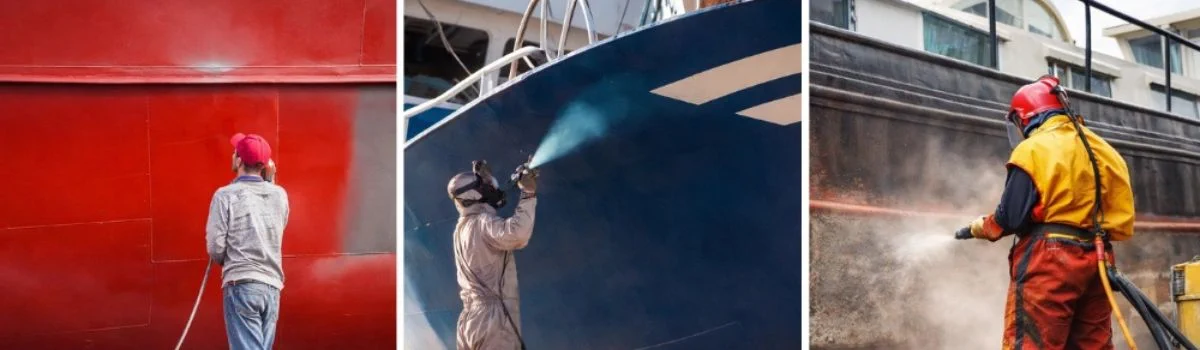
Over 75% of premature industrial coating and paint failures across Pakistan—spanning crude oil storage tanks in Kemari and Port Qasim, chemical processing columns in Hub, ship hulls at Karachi Shipyard (KS&EW), and cross-country natural gas transmission lines—are caused not by inferior paint formulation, but by inadequate surface preparation.
Applying expensive marine-grade epoxy or polyurethane coatings over mill scale, invisible chloride salts, grease residues, or an improperly profiled substrate guarantees catastrophic osmotic blistering, under-film creep corrosion, and premature delamination within 12 to 18 months.
Achieving certified surface cleanliness and a uniform anchor profile according to ISO 8501-1 and SSPC / NACE standards is the non-negotiable foundation of multi-decade asset protection.
ISO 8501-1 vs. SSPC / NACE Visual Cleanliness Standards
Abrasive blast cleaning is classified internationally into visual surface cleanliness grades that define the allowable percentage of microscopic shadows and streaks remaining on the steel:
1. SA 1 (Light Blast Cleaning / Brush-Off - SSPC-SP 7 / NACE 4)
- Visual Standard: Removes loose mill scale, loose rust, and foreign matter. Tight mill scale and firmly adhering rust remain intact.
- Suitability: Completely unacceptable for heavy industrial protective coating systems; only used for temporary touch-ups or low-grade architectural maintenance.
2. SA 2 (Thorough Commercial Blast Cleaning - SSPC-SP 6 / NACE 3)
- Visual Standard: Removes almost all rust, mill scale, and paint. At least two-thirds (67%) of each square inch must be free of all visible residue.
- Suitability: Acceptable for non-critical structural steelwork in arid interior zones (Punjab / KPK), standard indoor machinery, and low-cost alkyd primer systems.
3. SA 2.5 (Near-White Metal Blast Cleaning - SSPC-SP 10 / NACE 2)
- Visual Standard: The universal benchmark across global heavy industry. At least 95% of each square inch of surface must be completely free of all visible oil, grease, dirt, mill scale, rust, paint coatings, and foreign matter. Only very light shadows, streaks, or minor discolorations caused by rust staining are permissible across the remaining 5%.
- Mandatory Application: Required by major Pakistani asset owners (PSO, Shell, PARCO, Engro, OGDCL) for high-build marine epoxy tank linings, offshore structures, bridge girders, and external chemical pipeline coatings.
4. SA 3.0 (White Metal Blast Cleaning - SSPC-SP 5 / NACE 1)
- Visual Standard: Absolute 100% uniform white metallic substrate with zero traces of shadows, rust stains, mill scale, or discoloration.
- Mandatory Application: Critical chemical immersion services (concentrated acid/alkali storage tanks), pressurized boiler interiors, and subsea offshore pipelines where any microscopic defect would result in catastrophic pinhole lining failure.
Surface Cleanliness Cross-Reference Matrix
The Anchor Profile ($R_y / R_z$): The Mechanical Key to Paint Adhesion
Surface cleanliness alone is insufficient; protective coatings cannot adhere to polished or smooth steel. Abrasive blasting fractures the metal surface, creating a jagged microscopic landscape of peaks and valleys known as the anchor pattern or surface profile:
- The Danger of Shallow Profiles ($<35 mu ext{m}$): Fails to provide sufficient mechanical keying. The primer film sits on a flat surface, leading to adhesive shear failure and peeling under mechanical vibration or thermal expansion.
- The Danger of Deep Profiles ($>85 mu ext{m}$): If large coarse abrasive creates excessively deep valleys, the microscopic steel peaks will project through the primary primer coat. The dry film thickness (DFT) over these peaks will be inadequate, causing premature "pinpoint rusting" that rapidly spreads beneath the paint system.
- Optimal Target Range: For high-performance two-pack zinc-rich and epoxy primers, the industry standard anchor profile is 50 to 75 microns (2.0 to 3.0 mils).
Precision Profile Verification:
Quality control inspectors utilize Testex Press-O-Film replica tape (Coarse and X-Coarse) paired with calibrated digital micrometers, or digital surface profile gauges like the Elcometer 224, logging peak-to-valley measurements across the blasted substrate for client QA/QC dossier handover.
Abrasive Blast Media Selection: Copper Slag vs. Garnet vs. Steel Grit
Choosing the right abrasive directly dictates surface cleanliness speed, anchor profile consistency, operator health, and media reusability:
1. Copper Slag (Iron Silicate)
- Physical Characteristics: Fast-cutting, highly angular black synthetic aggregate derived from copper smelting slag (Mohs hardness 7.0–7.5).
- Economic Role: Inexpensive single-pass abrasive. Widely used for open-air dry blasting across Pakistani shipyards, structural steel fabrication yards, and external fuel storage tanks where abrasive containment and recovery are impossible.
- Limitation: High dust generation; breaks down into fine dust upon first impact, preventing reuse.
2. Almandine Garnet (Premium Mineral Abrasive)
- Physical Characteristics: Natural, semi-precious mineral rock abrasive with high specific gravity (4.1 g/cm³) and Mohs hardness 7.5–8.0. Chemically inert and sub-angular.
- Health & Safety Advantage: Contains less than 0.5% free crystalline silica, completely eliminating operator silicosis risks and dramatically improving job site visibility by generating up to 50% less dust than copper slag.
- Recyclability: In enclosed blast rooms or recovery hoppers, high-purity garnet can be reclaimed and recycled 3 to 5 times, drastically reducing disposal costs on long-term fabrication contracts.
- Ideal For: Stainless steel pipework, aluminum decks, and marine offshore structures where ferrous contamination from slag or steel grit is prohibited.
3. Steel Grit (GL/GH) & Steel Shot
- Recyclability: Recyclable 100 to 200 times in automated abrasive recovery systems.
- Application: The standard for indoor blast rooms and centrifugal wheel-blast machines for structural I-beams, pre-engineered building components, and pipe spool pre-fabrication.
> CRITICAL SAFETY WARNING: Banned Silica Sand
> Using raw river sand or unwashed quartz silica sand for abrasive blasting is strictly banned under modern international occupational health regulations. Impact shattering pulverizes crystalline silica ($SiO_2$) into respirable sub-micron particles that lodge permanently in operators' lungs, causing incurable, fatal silicosis. Modern Pakistani HSE standards strictly mandate synthetic slags, mineral garnet, or steel abrasives.
Blast Aerodynamics: CFM, Venturi Nozzles & Pressure Drop
Abrasive blast pots rely on compressed air mass flow to accelerate heavy media through blast hoses:
- Venturi Nozzle Physics: Modern Laval-profile Venturi blast nozzles (engineered with a converging entrance, narrow throat, and diverging exit) accelerate abrasive particles to supersonic speeds exceeding 720 km/h (450 MPH), delivering a 40% larger blast pattern and 30% higher production speed compared to straight-bore nozzles.
- The "1 PSI = 1.5% Loss" Law: Operating pressure measured directly at the nozzle entrance must be sustained at 6.9 to 7.0 bar (100 PSI). For every single PSI drop below 100 PSI (caused by undersized compressors, long airline runs, or leaky couplings), the blasting rate drops by 1.5%. Blasting at 80 PSI reduces contractor production speed by nearly 30% while consuming the same labor.
Air Consumption Guide for Clemco Venturi Nozzles:
- No. 5 (5/16" - 8.0mm Orifice): Requires 140 CFM at 100 PSI (Requires a minimum 45 HP to 50 HP compressor).
- No. 6 (3/8" - 9.5mm Orifice): Requires 196 CFM at 100 PSI (Requires a minimum 60 HP compressor).
- No. 7 (7/16" - 11.0mm Orifice): Requires 254 CFM at 100 PSI (Requires a minimum 75 HP to 80 HP compressor).
High-Pressure Airless Spray Coating & The 4-Hour Karachi Window
Once an SA 2.5 near-white blast is achieved, the freshly exposed reactive steel substrate must be protected immediately:
- Airless Spray Atomization: Unlike conventional compressed air spray guns that introduce air bubbles and solvent entrapment, heavy-duty pneumatic airless spray pumps (45:1 to 68:1 fluid-to-air pressure ratios) pressurize high-solid marine epoxies up to 300 bar (4,300 PSI). Fluid is forced through tungsten carbide spray tips, creating a uniform, pinhole-free film thickness.
- The 4-Hour Flash Rust Rule in Coastal Karachi: Along the Arabian Sea coast (Port Qasim, Clifton, KPT, Kemari), relative atmospheric humidity frequently exceeds 75% to 85%. Bare blasted steel reacts aggressively with airborne moisture and microscopic salt aerosols.
- Application Window: Primer application must occur within 4 hours of abrasive blasting. Blasting after 3:00 PM on coastal outdoor jobsites is strongly discouraged, as evening dew will induce rapid flash rusting on unprimed steel before paint cures.
- Environmental Parameters: Never apply protective coatings if:
1. The ambient Relative Humidity (RH) exceeds 85%.
2. The steel surface temperature is less than $3^circ ext{C}$ ($5^circ ext{F}$) above the ambient dew point.
Surface Preparation & Inspection Equipment at Alsons Hardware
As an established distributor of industrial surface treatment technology, Alsons Hardware equips contractors, shipyards, and refineries across Pakistan:
- Genuine Clemco pressure blast pots (50L, 100L, 200L capacity) with remote control deadman valves and abrasive metering valves.
- High-durability Tungsten Carbide and Boron Carbide Venturi blast nozzles with silicone rubber jackets.
- Certified Apollo 600 blast helmets, climate control ambient air cooling tubes, and breathing air filter packs.
- Complete Elcometer coating inspection instruments: surface profile gauges, wet/dry film thickness gauges, and Bresle salt test kits for soluble chloride contamination audits.
- Imported high-purity GMA Almandine Garnet (80 mesh / 120 mesh) and certified angular Copper Slag abrasive media.
Explore our full inventory under Sand Blasting Equipment at Alsons Hardware or consult our engineers under Machining & Engineering Services.
Frequently Asked Questions
What is the exact visual difference between SA 2.5 and SA 3.0 blasting standards?
SA 2.5 (Near-White Metal) requires at least 95% of each square inch to be completely clean bare metal, permitting up to 5% of light shadows, streaks, or faint discolorations. SA 3.0 (White Metal) demands 100% pure metallic substrate with zero shadows or staining whatsoever.
Can I reuse copper slag abrasive media for multiple blasting jobs?
No. Copper slag is a brittle, amorphous aggregate that shatters into fine airborne dust on initial high-velocity impact, losing its angular cutting edges. Attempting to reuse slag creates severe dust blinding and fails to produce an acceptable anchor profile. If recyclability is required, use Almandine Garnet (reusable 3 to 5 times) or Steel Grit (reusable 100+ times).
Why must blast profile depth be measured before applying the primer coat?
If the blast profile is too shallow ($<35 mu ext{m}$), the coating cannot mechanically lock into the steel, causing delamination. If it is too deep ($>85 mu ext{m}$), the primer will not fully encapsulate high steel peaks, causing rapid "pinpoint rusting" along the protruding steel tips.
What is the minimum compressor size needed to run a single sandblasting pot?
For a standard production #6 (3/8" orifice) Venturi blast nozzle running at 100 PSI, you require a minimum 200 CFM rotary screw air compressor (approximately 50 HP to 60 HP), plus additional air if supplying an operator Apollo air-fed breathing helmet.