A definitive structural engineering guide comparing I-Beams (IPE/IPN) and wide-flange H-Beams (HEA/HEB/UC) for PEB buildings, overhead crane runway girders, and commercial fabrication in Pakistan.
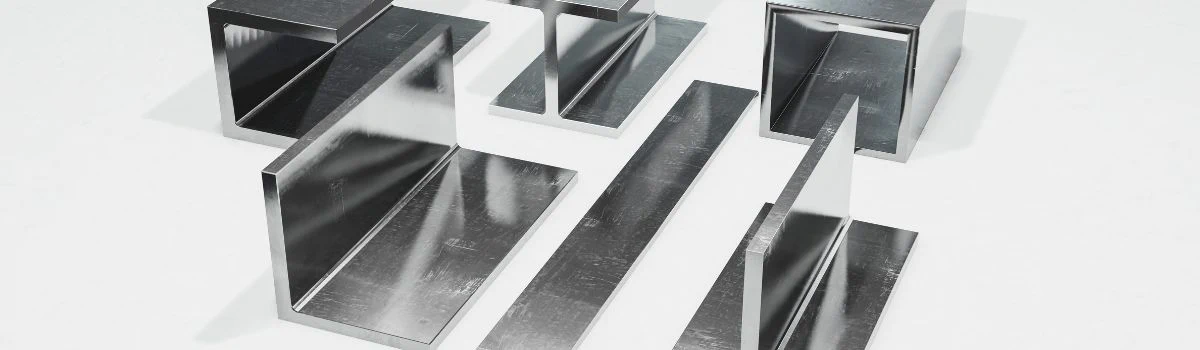
Whether you are erecting a Pre-Engineered Building (PEB) warehouse in Hub Industrial Zone, fabricating a heavy industrial processing plant in Port Qasim, or designing an overhead crane runway in Karachi or Lahore, selecting the correct structural steel profile is fundamental to structural safety, structural weight efficiency, and cost control.
A common and potentially dangerous pitfall in local Pakistani construction is treating standard I-Beams (IPE / IPN) and H-Beams (HEA / HEB / HEM / Universal Columns) as interchangeable. While both are hot-rolled structural steel sections shaped like the letter "I" or "H", their mechanical properties, cross-sectional geometry, bending axis behaviors, and weight-to-load capacities diverge substantially.
Confusing an I-Beam with an H-Beam in column design can lead to catastrophic lateral torsional buckling, while using an H-Beam where an I-Beam suffices adds unnecessary tonnage, drastically inflating material and freight budgets.
Geometric Architecture: Flange Geometry & Section Modulus
The fundamental engineering distinction between I-Beams and H-Beams lies in their cross-sectional proportions, flange slopes, and mass distribution relative to their principal axes:
1. I-Beams (IPE / IPN Profiles)
- Flange Geometry: Standard European I-Beams (IPE) feature parallel outer flanges with a slight internal taper, whereas traditional IPN sections have a 14% inner slope. The flange width is significantly narrower than the total section height (depth-to-width ratios typically range from 2:1 to 3:1).
- Flexural Profile: The concentrated mass in the top and bottom flanges separated by a relatively thin vertical web creates a high moment of inertia along the strong axis ($I_x$).
- Axis Asymmetry: While highly efficient at carrying pure vertical bending moments, their narrow flanges deliver very low resistance to lateral torsional buckling ($I_y$). An unbraced I-beam subjected to lateral or torsional forces will twist and buckle prematurely.
2. H-Beams (HEA / HEB / HEM / Universal Columns)
- Flange Geometry: Wide-flange H-Beams feature thick, perfectly parallel flanges where the flange width is often equal or nearly equal to the section depth (depth-to-width ratio close to 1:1 or 1:1.2 on sections up to 300mm).
- Mass Distribution: Significantly thicker webs and wider flange plates distribute structural mass evenly across both axes.
- Bi-Axial Rigidity: The broad parallel flange configuration dramatically elevates the weak-axis moment of inertia ($I_y$) and the radius of gyration ($r_y$). This enables H-Beams to resist heavy bi-axial bending, torsional rotation, and high axial compressive stresses simultaneously.
Technical Comparison: IPE vs. HEA vs. HEB
Application Guidelines: Where to Specify Each Profile in Pakistan
1. Horizontal Roof Rafters & Secondary Mezzanine Beams: Specify I-Beams (IPE)
In pre-engineered warehouse buildings and commercial canopies, rafters and mezzanine floor joists experience predominantly unidirectional gravity loads (dead weight, live load, and wind uplift). Because the roof purlins or composite concrete decking provide continuous lateral restraint to the compression flange, the weak-axis vulnerability of the I-beam is effectively neutralized. Specifying IPE 160 through IPE 360 yields maximum span-to-weight efficiency, reducing overall steel procurement costs by 15% to 25% compared to over-designed wide-flange profiles.
2. Main Vertical Columns & Seismic Frames: Specify H-Beams (HEA / HEB)
Under the Building Code of Pakistan (BCP), industrial structures located in coastal seismic zones like Karachi (Zone 2B) and northern zones like Quetta or Peshawar (Zones 3 and 4) must accommodate combined vertical dead/live loads, horizontal wind shears (up to 120 km/h gusts), and cyclic ground acceleration. Vertical building columns undergo axial compression combined with bi-axial bending moments. Narrow I-beams will fail by elastic buckling around the weak axis long before reaching their material yield strength. Specifying wide-flange HEA or HEB sections (HEA/HEB 200 to HEA/HEB 500) provides the radius of gyration necessary to satisfy slenderness ratio limits ($KL/r \le 200$) without requiring excessive intermediate bracing.
3. Overhead Crane Runway Girders: Specify HEB or Reinforced Sections
Overhead bridge cranes subject runway beams to severe dynamic stress cycles: vertical wheel loads, longitudinal traction/braking forces, and transverse crabbing impact forces as the trolley accelerates across the bridge. A standard IPE beam will rapidly experience web crippling or flange twist under crane wheel loads. Professional crane runway designs utilize HEB profiles or compound sections (HEB with a top-flange structural channel cap or crane rail welded along the centerline). For specialized overhead crane runway fabrication and proof load testing, review Alsons Hardware's Machining & Engineering Services.
Material Standards: Prime Mill Certified vs. Rerolled Scrap
A pervasive risk across Pakistan's industrial steel markets is the prevalence of uncertified rerolled steel derived from shipbreaking scrap (Gaddani). While rerolled sections may resemble standard profiles visually, laboratory metallurgical testing reveals severe deficiencies:
- Chemical Non-Uniformity: Elevated carbon equivalents ($CEV > 0.45$), sulfur, and phosphorus lead to brittle heat-affected zones (HAZ) and catastrophic cracking during welding.
- Dimensional Variances: Variable web thicknesses and uneven flange tapers compromise bolt hole alignment and load transfer through connection gusset plates.
- Unpredictable Yield Strength: Lacking controlled thermal-mechanical rolling, rerolled sections frequently fail to meet minimum 250 MPa yield criteria under proof testing.
Certified Prime Steel Specifications
For critical infrastructure and industrial projects, structural engineers must specify prime sections manufactured to international standards:
- ASTM A36: Minimum yield point $F_y = 250\text{ MPa}$ ($36\text{ ksi}$), tensile strength 400–550 MPa; standard structural carbon steel for commercial fabrication.
- EN 10025 S275JR: European standard structural steel with guaranteed yield strength $F_y = 275\text{ MPa}$ and Charpy impact energy at room temperature (27 Joules at 20°C).
- EN 10025 S355JR / S355J2: High-strength structural steel with $F_y = 355\text{ MPa}$ and guaranteed low-temperature impact toughness (-20°C for J2 grade), mandatory for heavy industrial portals and dynamic crane girders.
At Alsons Hardware, all imported structural steel profiles are accompanied by traceable Mill Test Certificates (MTC / EN 10204 3.1) documenting complete chemical heat ladle analysis, mechanical yield/tensile testing, and ultrasonic flaw testing.
Marine & Coastal Corrosion Protection in Pakistan
Projects located within 15 km of the Arabian Sea coastline—including Port Qasim, Korangi Creek, West Wharf, Clifton, and Gwadar—are subject to harsh marine atmospheric corrosivity (ISO 12944 Category C4 to C5-M). Unprotected structural steel can experience section loss rates exceeding 0.1mm to 0.2mm per year.
To guarantee 25+ year structural service lives:
1. Surface Preparation: Structural profiles must undergo abrasive blast cleaning to SSPC-SP10 / ISO 8501-1 Sa 2.5 (near-white blast) to remove mill scale, grease, and oxidation.
2. Shop Priming: Application of a two-pack zinc-rich epoxy primer (minimum 75 microns dry film thickness / DFT) directly after blasting.
3. Hot-Dip Galvanizing: For exposed external structures, marine trestles, and offshore pipe racks, batch hot-dip galvanizing to ASTM A123 / ISO 1461 delivers an impermeable metallurgical zinc-iron alloy barrier that provides galvanic sacrificial protection against salt fog and marine spray.
Precision Shop Fabrication & Nationwide Logistics
Sourcing structural steel for pre-engineered frames requires precise shop fabrication before site erection:
- Precision Cold Saw Cutting & Coping: Clean, square beam ends and web cutouts tailored to joint detailing drawings.
- CNC Hole Punching & Drilling: Exact hole patterns for high-strength friction-grip (HSFG) structural bolts (ASTM A325 / Grade 8.8).
- Welded Base & End Plates: Submerged arc and GMAW welding of certified connection plates by qualified welders. Learn more about our specialized rigging and assembly capabilities under Custom Fabrication Services.
Headquartered in the commercial steel trading hub of Serai Road, Karachi, Alsons Hardware coordinates crane loading, certified delivery challans, and articulated flatbed transport to project sites across Sindh, Punjab, Balochistan, and Khyber Pakhtunkhwa.
Frequently Asked Questions
Can I use an I-beam (IPE) as a primary vertical column for a warehouse building?
While technically feasible for very light single-storey canopies with close intermediate bracing, I-beams make poor vertical columns. Under high axial loads and wind moments, an I-beam's narrow flanges offer minimal resistance around the weak axis (Y-Y), causing it to buckle prematurely. Wide-flange H-beams (HEA/HEB) provide the balanced radius of gyration required for structural column stability.
What is the main structural difference between HEA and HEB beams of the same nominal size?
An HEB section is the heavy-standard version of an HEA section. For example, while an HEA 200 and HEB 200 both have a nominal 200mm depth, the HEB profile has thicker flanges (15mm vs. 10mm) and a thicker web (9mm vs. 6.5mm). Consequently, HEB 200 carries substantially higher load-bearing capacity (61.3 kg/m vs. 42.3 kg/m) and exhibits higher moment capacity.
How do I verify that structural steel delivered to my site is genuine prime mill steel rather than rerolled scrap?
Request the manufacturer's official Mill Test Certificate (MTC 3.1) and verify that the heat number and mill stamp on the steel section's web match the documentation. Furthermore, check dimensional consistency along the entire 12-meter length and inspect for consistent surface finish free of laminations, pits, or re-rolling seams.
Does Alsons Hardware supply standard lengths or cut-to-size structural steel profiles?
We stock standard 6-meter and 12-meter commercial lengths, and provide precision in-house cold cutting, mitre cutting, base plate welding, and hole drilling to client CAD shop drawings for rapid bolt-together site assembly.